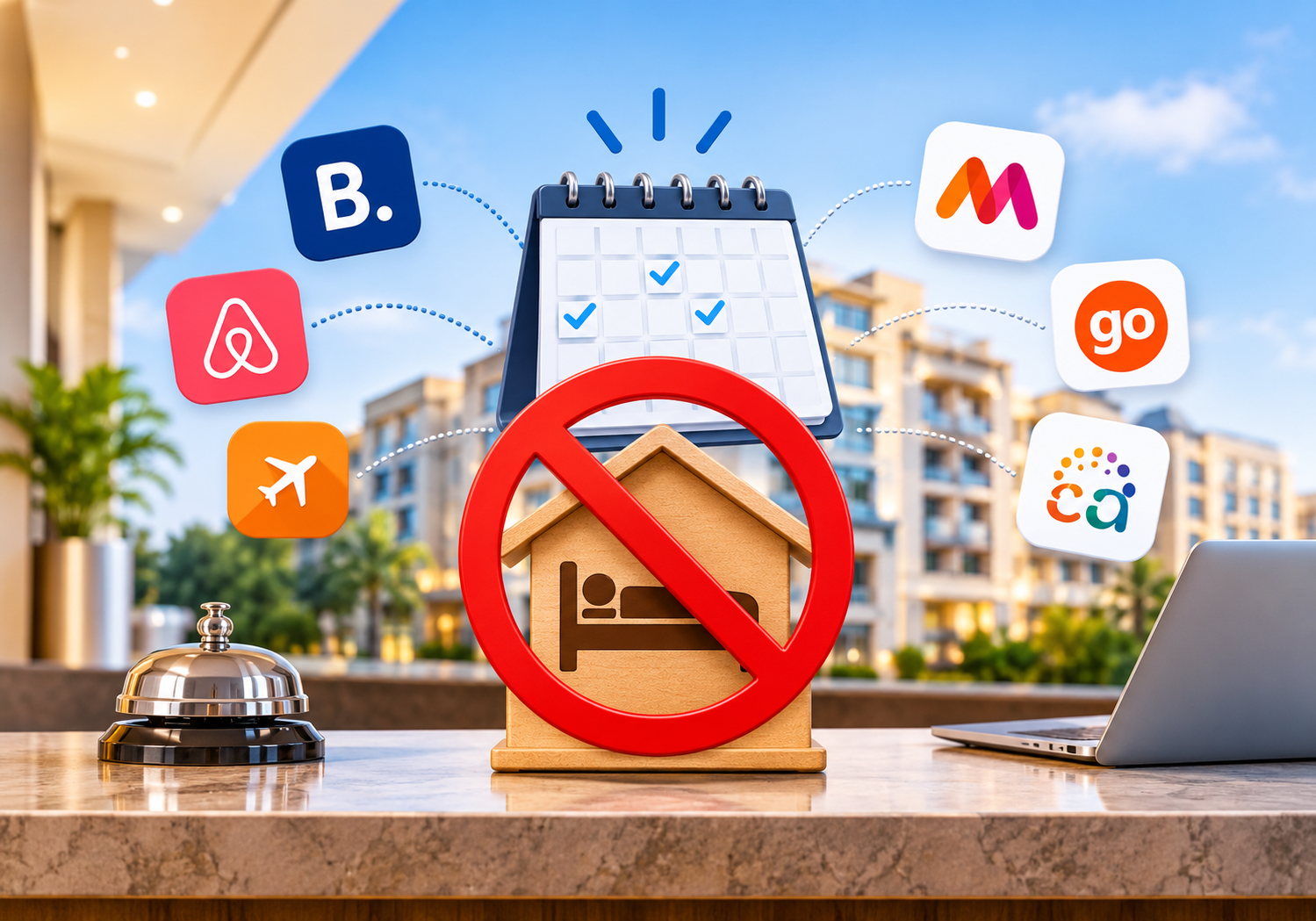

Avoid overbooking, and you protect your guests, your reviews, and your revenue. 🎯 Most Indian hotels sell rooms on MakeMyTrip, Booking.com, Agoda, and Goibibo at the same time. That reach brings more bookings. It also brings a hidden risk. One room can sell twice within a single minute. 😰
A double booking means an angry guest at your front desk. It means a forced walk-out, a refund, and often a one-star review. This guide shows you how to avoid overbooking with simple systems. Any hotel, resort, villa, or homestay can follow them. ✅
💡 Want fewer OTA headaches? List your property with StayWithUs. Pay 7% only on confirmed bookings, with ₹0 setup fee. 👉 List your property now
🤔 What Is Overbooking and Why Does It Happen on OTAs?
Overbooking means you confirm more reservations than you have rooms. Airlines plan for it on purpose. Small hotels almost never should.
Accidental overbooking happens when your rooms sit on many platforms. Each platform keeps its own calendar. If those calendars do not talk to each other, every platform thinks the room is free.
Here is a common example. 🛏️ You have one Deluxe Room. A guest books it on Agoda at 9:00 AM. Your Booking.com calendar still shows the room as open. A second guest books it at 9:02 AM. Now you owe two guests one room.
Three causes create most double bookings:
- ⏱️ Sync delays between OTA extranets
- ✍️ Manual updates that are late or forgotten
- 📞 Offline bookings from calls and walk-ins that never reach the OTA calendars
Knowing these causes is step one. Next, let us look at what the damage costs.
💸 What Overbooking Really Costs Your Hotel
Many owners think a double booking costs one night of revenue. The real cost is much larger.
First, you must find another room for the guest. That usually means a nearby hotel, paid by you. Second, the OTA may add a penalty or lower your listing visibility. Third, the guest may post a public review. 😡
Reviews matter more than most owners expect. Future guests read them before they book. One story about a relocated family can cost you many future bookings.
There is also a trust cost. Families who travel far to a hill station or beach remember being turned away. Your team also feels the stress on a busy check-in day.
So the smart move is clear. You must avoid overbooking before it happens. Here are nine ways to do it. 👇
✅ 9 Proven Ways to Avoid Overbooking on Multiple OTAs
1. 🔄 Use a Channel Manager
A channel manager is software that links all your OTA calendars. When one room sells, every other platform closes that room within seconds. This is the most effective way to avoid overbooking. Without it, you update each extranet by hand. That works for two rooms. It fails at twenty.
Tools like SaasAro solve this problem. SaasAro is a hotel management platform with a built-in channel manager. It connects to 100+ OTAs and syncs your rooms and rates from one dashboard. ✅ A booking on one platform closes that room everywhere else. Your team stops juggling extranets.
Read our Channel Manager for Hotels in India buyer’s guide to compare features and options.
2. 📒 Keep One Master Inventory
Pick a single source of truth for room availability. It can be your channel manager, your property management system, or a shared sheet for very small properties.
Every booking, from any source, must be entered there first. Never trust OTA dashboards alone. Each one shows only its own view of your rooms. One master list helps you avoid overbooking on every channel.
3. 🎯 Set Room Allotments Per OTA
Do not give every OTA your full inventory. Split your rooms across platforms instead. A 10-room hotel might give 4 rooms to Booking.com, 3 to Agoda, and 3 to MakeMyTrip.
Keep a few rooms off the OTAs for direct and phone bookings. Review the split every month. Move rooms to the platform that actually sells them.
4. 🛡️ Keep a Safety Buffer
Never sell your last room online on busy dates. Close sales when one room remains. Save it for walk-ins, repeat guests, or emergencies.
This small habit costs very little. It can save your worst check-in day. A buffer helps you avoid overbooking during festivals, long weekends, and peak season.
5. ⚡ Choose Instant Confirmation Carefully
Some OTAs offer request-to-book instead of instant booking. For rare, high-demand rooms, request mode gives you time to check availability first.
Instant booking converts better. So use it for most rooms. Use request mode only for your last few units to avoid overbooking.
6. 🔍 Audit Calendars Every Day
Even good software can fail. Connections break. Logins expire. Rate plans get mapped to the wrong rooms.
Spend ten minutes each morning comparing calendars. Check the next 30 days on every OTA. Confirm they match your master inventory. A daily audit is cheap insurance to avoid overbooking. 🔐
7. 👥 Train Your Front Desk With a Simple SOP
Software cannot stop a tired receptionist from making a mistake. Write a one-page process and train every shift.
Include these steps:
- 📝 Log every phone and walk-in booking immediately
- 🔒 Block that room in your master inventory
- ✅ Confirm the block shows on each OTA
- 🔁 Recheck everything at day end
Staff follow rules better when they know why the rules exist. Explain the real cost of one double booking. Training is a low-cost way to avoid overbooking.
8. 💰 Price Smartly to Control Demand
When your last rooms are selling fast, raise the rate. Higher prices slow demand and protect your inventory. They also lift revenue per room.
Learn more in our Hotel Room Pricing Strategy guide. Good pricing and good inventory control work together. 📈
9. 🚀 Grow Direct Bookings With Your Own Booking Engine
Every OTA you add raises the risk of a calendar mismatch. Direct bookings help you avoid overbooking because you manage fewer calendars. They also remove heavy commissions.
Read OTA vs Direct Booking to see how both channels compare. Then learn how to increase direct hotel bookings step by step.
❌ 6 Mistakes That Make Overbooking More Likely
Most double bookings trace back to a few habits. Fix these first if you want to avoid overbooking for good.
- 🙈 Trusting one OTA calendar as the full truth
- ⏳ Updating inventory once a day instead of after each sale
- 📵 Ignoring phone and WhatsApp bookings in the system
- 🔀 Mapping rooms wrongly between OTAs and your system
- 🎉 Selling every room during festivals and long weekends
- 🤷 Having no owner for inventory, so nobody checks it
Notice the pattern. None of these mistakes needs expensive tools to fix. They need clear ownership and a simple routine. Name one person per shift as the inventory owner. That single step helps you avoid overbooking faster than any new software.
📊 Manual Updates vs Channel Manager
| Factor | ✍️ Manual Updates | 🔄 Channel Manager |
|---|---|---|
| Update speed | Minutes to hours | Seconds |
| Human error risk | High | Low |
| Best for | 1 to 5 rooms | 5 rooms and above |
| Daily time needed | 30+ minutes | 10 minutes |
| Help to avoid overbooking | Limited | Strong |
🏨 Where to List Without Adding Risk
Not every listing needs a new calendar to babysit. Choose platforms with care. Each new OTA adds one more calendar to watch. Plan your channel mix to avoid overbooking from day one.
Start with the platforms that already bring you guests. Our guides on how to list a property on Booking.com, Agoda, and Goibibo explain each setup. You can also read Where to List Hotel Online for a wider view.
Watch the cost side too. Commissions and hidden charges add up fast. Our post on OTA hidden fees for hotels shows where profit leaks. Our guide on OTA commission dependency shows how to reduce it. 💡
StayWithUs is a booking engine built for Indian properties. It charges 7% on confirmed bookings only, with ₹0 setup or subscription fee. You pay nothing when a room does not sell. 🙌
🏔️ Peak Season Plan to Avoid Overbooking
Festival weeks and long weekends are the riskiest days. Demand rises, bookings arrive faster, and mistakes multiply. A short plan helps you avoid overbooking when it matters most. 🎊
Two weeks before a peak date, audit every calendar. Remove old blocks and fix rate plans. One week before, hold back one or two rooms as a buffer. Raise rates as occupancy climbs.
On the peak day itself, check calendars twice. Check once in the morning and once in the evening. Assign extra front desk help if possible. Keep a tie-up with a nearby property as a backup. Many hoteliers skip this step, then regret it.
After the peak, review what happened. Note which OTA sold fastest and which sync was slow. Use those notes to tune your allotments next season. 📝
🆘 What to Do If Overbooking Happens Anyway
Even careful hotels make a mistake once. Respond fast and honestly.
- 📞 Call the guest before arrival if you can. Early notice reduces anger.
- 🏨 Find a similar or better room nearby. Pay the price difference.
- 🚗 Arrange free transport to the new hotel.
- 💬 Apologise sincerely and offer a discount on the next stay.
- 📋 Inform the OTA and follow its relocation policy.
- 🔧 Find the root cause and fix it the same day.
Honest handling often saves the review. Guests forgive mistakes. They rarely forgive silence.
📋 Your Daily Checklist to Avoid Overbooking
Print this list and keep it at the front desk:
- ☑️ Compare all OTA calendars with your master inventory
- ☑️ Log every offline booking within minutes
- ☑️ Close the last room on peak dates
- ☑️ Check sync alerts from your channel manager
- ☑️ Review tomorrow’s arrivals against room status
💡 Expert tip from the StayWithUs team: Treat availability like cash. Every sale must be recorded in one place, at once. Hotels that follow this rule rarely face a double booking.
🏁 Conclusion
Selling on many OTAs is smart. It builds reach, trust, and steady demand. But reach without control creates risk. 🎯
To avoid overbooking, start with one master inventory and a channel manager. Add allotments, buffers, daily audits, and a trained front desk. Then grow direct bookings so you depend less on every calendar.
Small habits protect big revenue. Start with one change today. Your guests, your team, and your reviews will thank you. 🌟
🚀 Ready to sell smarter? List your property with StayWithUs today. 7% on confirmed bookings only, ₹0 setup. 👉 List your property or call +91 75000 87037 📞
❓ FAQs: Avoid Overbooking on Multiple OTAs
Q1. What is the best way to avoid overbooking on multiple OTAs?
Use a channel manager with one master inventory. It updates every OTA calendar within seconds of a sale. Add daily audits and a safety buffer for extra protection.
Q2. Can small hotels and homestays avoid overbooking without software?
Yes, but it needs strict discipline. Keep one shared calendar, update it after every booking, and check each OTA daily. Software becomes necessary as your room count grows.
Q3. Who pays if a hotel overbooks a guest from an OTA?
The hotel usually pays. You must relocate the guest and cover the cost difference. The OTA may also apply a penalty, so read each platform’s policy.
Q4. How many rooms should I give each OTA?
There is no fixed rule. Start with a split based on past sales by platform. Keep a few rooms for direct bookings, then review the split monthly.
Q5. Does selling direct help avoid overbooking?
Yes. Direct bookings reduce the number of calendars you manage. They also save commission. Compare both channels in our guide on OTA vs direct booking.
Q6. How do I avoid overbooking during peak season?
Audit calendars two weeks ahead and hold back one buffer room. Check every OTA twice daily. Raise rates as rooms fill.