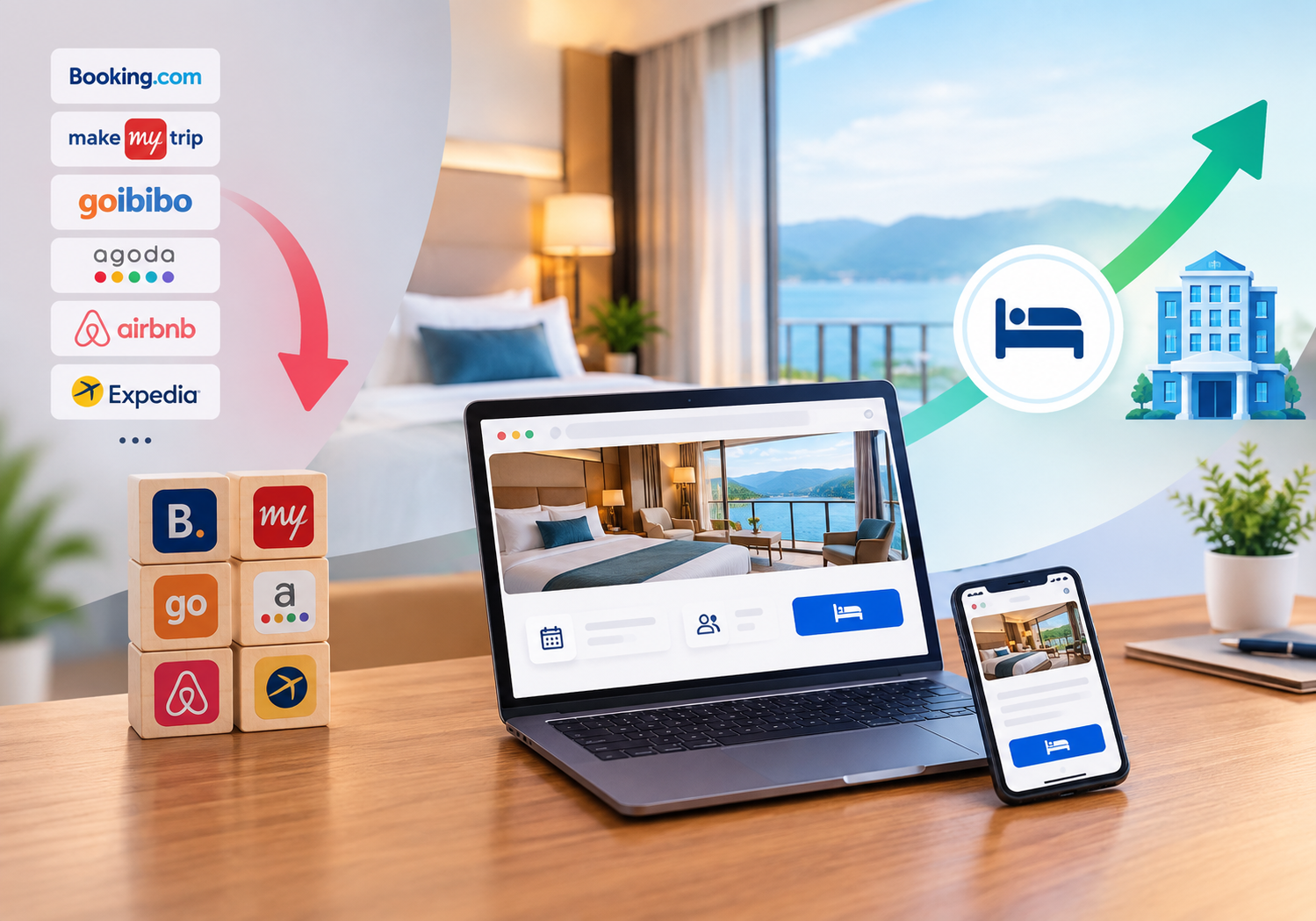

Reduce OTA dependency and you take back control of your pricing, your guest data, and your profits. 🏨 Most hotels still rely on Booking.com, MakeMyTrip, or Agoda for 80-90% of reservations. One algorithm change or rate parity dispute can quietly choke that revenue overnight.
Independent hotels, resorts, and homestays across India are waking up to a hard truth. OTAs bring visibility, but they also bring steep costs. 💸 Commissions run 15-25% per booking. Guest data stays locked inside the platform. Pricing rules get written by someone else, not you.
The good news? You don’t need to abandon OTAs entirely. You need a smarter balance, and this guide shows you exactly how.
This step-by-step plan will help you reduce OTA dependency using proven Indian hospitality tactics. By the end, you’ll have a practical roadmap, not just theory.
Why OTA Dependency Is Quietly Draining Your Hotel’s Profits
Most hoteliers only notice OTA dependency once a slow season hits. Occupancy drops the moment ad spend or ranking on the OTA platform slips.
Here’s what heavy OTA reliance actually costs you every single month:
- Commission bleed: 15-25% per booking adds up fast across hundreds of reservations
- Zero guest ownership: OTAs keep emails and phone numbers, not you
- Rate parity handcuffs: you can’t offer better direct deals without violating contracts
- Review dependency: your reputation lives on a platform you don’t control
- Algorithm risk: a policy change can bury your listing overnight
We’ve covered this pattern in detail in our post on how OTA commission dependency quietly drains hotel profits. It breaks down the real math behind those cuts.
Understanding this cost is the first step toward action. Properties that reduce OTA dependency early tend to recover margin faster than those who wait for a crisis.
Step 1: Build a Direct Booking Engine That Actually Converts
The single biggest lever to reduce OTA dependency is your own booking engine. 📲 It needs to be fast, mobile-friendly, and simple to use.
Guests already research on Google and Instagram before they book. Give them a frictionless way to reserve directly, without redirecting them anywhere else.
A strong booking engine should offer:
- Real-time availability synced with your OTA channels
- Secure payment gateway with multiple options (UPI, cards, wallets)
- Mobile-first design, since most Indian travelers book on phones
- Instant confirmation emails and SMS
- No hidden charges added at checkout
StayWithUs charges a flat 7% commission only on confirmed bookings. There are zero setup or subscription fees, which is often lower than what large OTAs quietly deduct. Choosing the right engine is central to any plan to reduce OTA dependency long-term.
If you’re comparing options, our breakdown of the best hotel booking engine in India for 2026 covers pricing and features.
👉 Ready to stop overpaying OTA commissions? List your property directly at StayWithUs and start collecting direct bookings this month.
Step 2: Strengthen Your Google Business Profile for Free Visibility
Google is quickly becoming the world’s largest OTA, and it costs nothing to appear there. 🔍 Guests searching “hotels near me” often see your Google listing before any OTA result.
To reduce OTA dependency through Google, focus on these basics:
- Complete profile with accurate address, phone, and amenities
- Fresh photos uploaded monthly, especially rooms and common areas
- Prompt replies to every guest review, good or bad
- Google Posts announcing offers, events, or seasonal packages
- A verified booking link pointing straight to your own engine
We’ve written a full walkthrough in our guide to optimizing your Google Business Profile for hotels, including exact verification steps. A strong local presence works alongside your booking engine to reduce OTA dependency without extra ad spend.
Properties that update photos and respond to reviews weekly typically see stronger direct-search visibility within a few months. This effort compounds over time and costs nothing beyond staff hours.
Step 3: Build a Guest Database and Bring Past Guests Back
Every guest who books through an OTA is a guest you may never reach again. 📧 Building your own database changes that permanently.
This is one of the most overlooked ways to reduce OTA dependency. It doesn’t require new technology or a bigger budget.
Simple ways to start collecting guest data:
- Ask for email at check-in for a digital receipt
- Offer a small discount for signing up to your newsletter
- Run a loyalty program with returning-guest perks
- Send personalized offers before major Indian holidays and long weekends
- Follow up after checkout asking guests to book direct next time
Guests who already trust your property are far more likely to skip the OTA next time. A simple WhatsApp follow-up often works better than a formal email for Indian travelers.
Over time, a well-maintained guest list becomes a strong tool to reduce OTA dependency without spending on ads. It also gives you a direct line during slow seasons.
Step 4: Target Corporate and Long-Stay Bookings Directly
Corporate travelers rarely browse OTAs the way leisure guests do. 💼 They book through travel desks, HR coordinators, or direct outreach instead.
This makes corporate business a high-value segment you can capture without paying any commission at all.
Steps to win corporate business directly:
- Create a simple corporate rate sheet with GST-compliant invoicing
- Reach out to nearby business parks, IT companies, and event planners
- Offer flexible cancellation terms for last-minute business travel
- List your property on corporate travel platforms alongside your own site
Our detailed playbook on winning corporate hotel bookings without relying on OTAs covers outreach templates that work well in India. Corporate accounts are a reliable, repeat channel to reduce OTA dependency across slow leisure seasons.
Even a handful of steady corporate clients can offset a meaningful share of OTA-driven revenue. This segment also tends to book longer stays with fewer cancellations.
Step 5: Use Social Proof and Content to Build Direct Trust
Guests need confidence before skipping the “safety” of a familiar OTA. ⭐ Reviews, photos, and real content build that trust on your own channels.
Effective trust-building tactics include:
- Publishing genuine guest testimonials on your website
- Sharing short video tours on Instagram Reels and YouTube Shorts
- Highlighting unique experiences your property offers, not just rooms
- Displaying certifications, safety measures, or sustainability practices
- Cross-linking your blog content to your direct booking page
Still deciding where to list? Our guide on where to list your hotel online in 2026 is a useful starting point.
Content marketing supports every other step here. It reinforces every tactic you use to reduce OTA dependency and builds trust over time.
A property blog that answers real guest questions also builds long-term organic traffic. Unlike OTA rankings, no algorithm update can take that traffic away from you.
Hidden Costs Most Hoteliers Miss
Beyond visible commissions, OTAs often add charges that quietly shrink your payout further. Recognizing these is essential if you want to reduce OTA dependency with full clarity.
Common hidden costs include:
- Payment processing fees deducted before payout
- Featured placement or “boost” fees for better visibility
- Cancellation and no-show policies that favor the guest
- Currency conversion charges on international bookings
- Promotional discounts you’re required to match
Understanding these deductions helps you calculate your true direct-booking savings more accurately. Many hoteliers are surprised by how much these small fees add up across a full year.
Once you see the real numbers on paper, the case to reduce OTA dependency becomes much easier to explain. Your team and investors will notice too.
Real Results: What Happens When You Reduce OTA Dependency
Properties that follow this roadmap typically see changes within the first two quarters. 📈 The shift isn’t instant, but it is measurable and it compounds.
Common early results include:
- Direct bookings climbing from under 20% to 35-40% of total reservations
- Average commission spend dropping by several lakh rupees annually
- A growing guest email and WhatsApp list ready for repeat outreach
- Higher guest satisfaction, since direct guests often get better rates
None of this requires abandoning OTAs overnight. It simply means each new booking channel you add helps you reduce OTA dependency a little further, month after month.
Consistency matters more than speed here. A property that steadily works to reduce OTA dependency for six months usually outperforms one that tries everything at once.
Small hotels and homestays sometimes see faster results than large resorts. Fewer approvals are needed to launch a new booking engine or profile update.
How Much Should You Actually Rely on OTAs?
The goal isn’t zero OTA bookings; it’s a healthy, balanced mix. 📊 Most successful independent properties in India now aim for a 50-60% direct booking share.
OTAs still play a role here, mainly for new guest discovery rather than as your primary channel.
A simple monthly checklist to track progress:
- Calculate your current OTA-to-direct booking ratio
- Set a realistic quarterly target to shift 5-10% more bookings direct
- Track commission savings and reinvest a portion into marketing
- Review which OTA channels genuinely bring new guests versus repeat ones
This balanced approach protects you from single-platform risk while you reduce OTA dependency. It also keeps discovery channels open for first-time guests.
Tracking this ratio monthly is the clearest way to measure whether your plan to reduce OTA dependency is actually working. Small, consistent shifts compound faster than most hoteliers expect.
Frequently Asked Questions
Q: What does it mean to reduce OTA dependency?
A: It means shifting a larger share of bookings to your own direct booking engine and channels, so your revenue isn’t controlled by a single OTA’s commissions or policies.
Q: How long does it take to see results after you reduce OTA dependency?
A: Most properties see a measurable shift within 3-6 months, once their booking engine, Google profile, and guest database are fully active.
Q: Will I lose bookings if I reduce OTA dependency too quickly?
A: Not if you keep a presence on major OTAs while building direct channels; the goal is balance, not sudden removal.
Q: Does StayWithUs charge setup fees for a direct booking engine?
A: No, StayWithUs charges zero setup or subscription fees and only 7% commission on confirmed bookings.
Q: Which is the fastest way to start reducing OTA dependency?
A: Setting up a direct booking engine and optimizing your Google Business Profile deliver the quickest visible results.
Final Thoughts: Take Back Control of Your Bookings
You don’t need to quit OTAs to build a healthier business. 🚀 You need a clear plan to reduce OTA dependency, applied step by step.
Start with one channel this month, whether it’s your booking engine or your Google profile. Build from there, and let momentum carry you into the next step.
Every direct booking you win is revenue, data, and guest loyalty you keep for good. Properties that act now will hold real pricing control in 2026, instead of waiting for the next commission hike.
👉 Take the first step today. List your property with StayWithUs and start building direct bookings with zero setup fees and just 7% commission on confirmed stays.