
OTA vs direct booking is the debate every hotel owner eventually faces. 📊
You list your property, guests start arriving, and then the commission invoices hit. Suddenly, the OTA vs direct booking question isn’t theoretical anymore.
This guide breaks down real costs, guest data ownership, and long-term growth. By the end, you’ll know exactly where to focus your energy in 2026.
🔍 What Does OTA vs Direct Booking Really Mean?
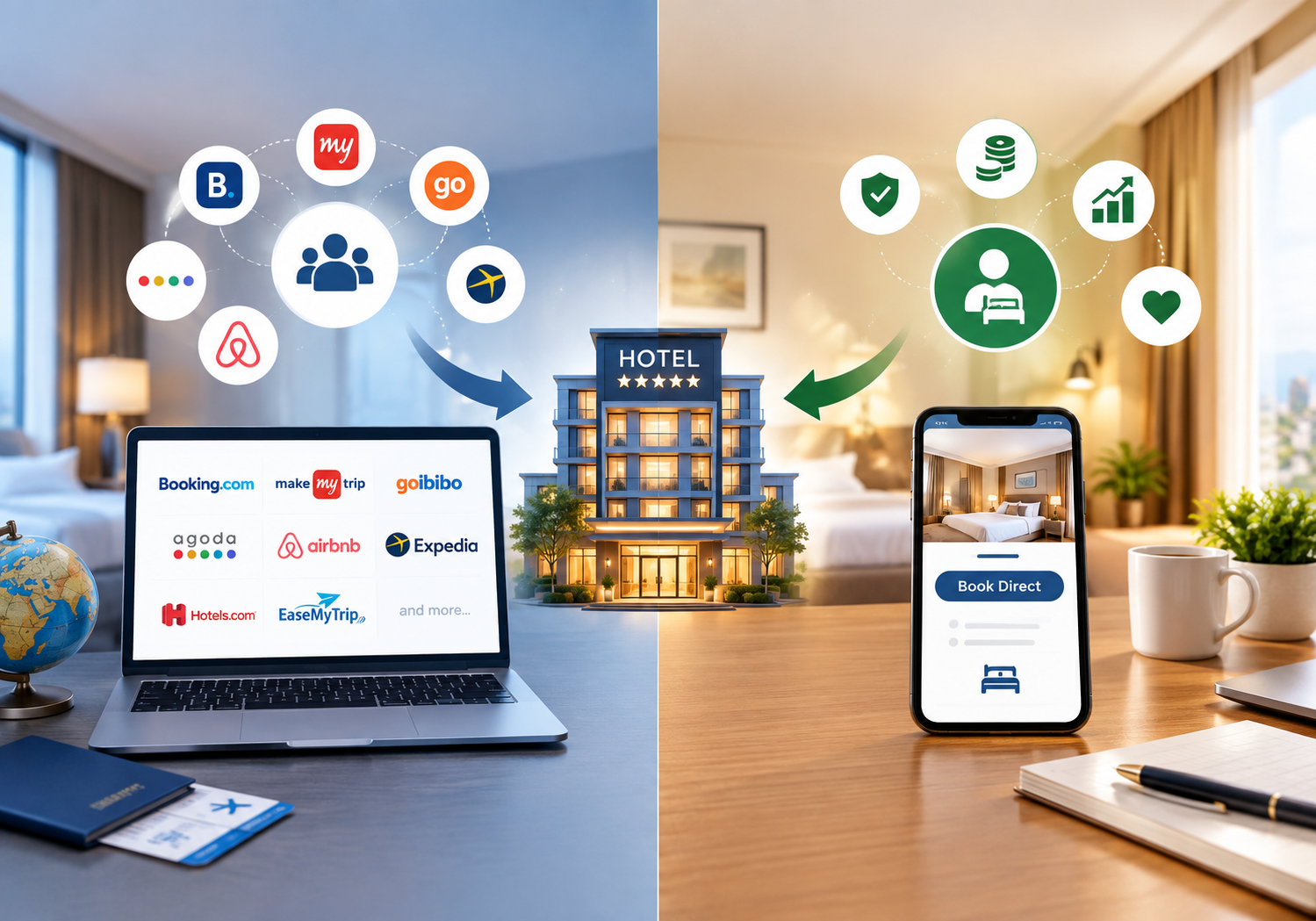
Online Travel Agencies (OTAs) like Booking.com, MakeMyTrip, and Agoda bring guests to your property. In exchange, they charge a commission per booking.
Direct booking means guests reserve rooms straight through your website or booking engine. No middleman. No commission cut.
The OTA vs direct booking comparison isn’t about picking one and abandoning the other. It’s about understanding where each channel earns its place in your strategy.
Most successful hotels in 2026 run both channels. But they lean harder into direct bookings once they understand the math.
💰 The Real Cost Difference
This is where OTA vs direct booking gets financially serious.
OTAs typically charge commissions ranging from 15% to 25% per booking. On a ₹5,000/night room, that’s ₹750–₹1,250 gone before you even cover operational costs.
Multiply that across hundreds of bookings monthly, and the number becomes staggering. Many hotel owners underestimate this until they actually sit down and calculate it.
We covered this in detail in our post on OTA commission dependency, where the numbers get even more specific.
Direct bookings through a platform like StayWithUs work differently. You pay just 7% commission on confirmed bookings only, with zero setup or subscription fees.
That’s a significant gap when you’re comparing OTA vs direct booking economics side by side.
📈 OTA vs Direct Booking: Quick Comparison Tabl
| Factor | OTA Booking | Direct Booking (StayWithUs) |
|---|---|---|
| Commission | 15–25% per booking | 7% on confirmed bookings only |
| Setup Fee | Often none, but hidden charges apply | ₹0 |
| Guest Data | Owned by OTA | Owned by you |
| Guest Relationship | Limited, transactional | Direct, repeatable |
| Visibility | High (OTA traffic) | Depends on your marketing |
| Control Over Pricing | Restricted by OTA policy | Full control |
This table alone shows why the OTA vs direct booking decision matters so much for margins. 💡
🎯 Who Owns the Guest Relationship?
Here’s something most new hotel owners miss in the OTA vs direct booking debate: data ownership.
When a guest books through an OTA, the OTA owns that relationship. You don’t get their email, their preferences, or a clean way to reach them again.
With direct bookings, you build your own guest database. You can email them next season. You can offer loyalty discounts. You can turn a one-time guest into a repeat customer.
This single difference compounds over years. A hotel with strong direct booking habits builds an audience. A hotel relying only on OTAs keeps starting from zero.
If you’re trying to build recognition beyond OTA listings, our guide on Google Business Profile for hotels pairs well with this strategy.
🌐 Visibility: Where OTAs Still Win
Let’s be fair in this OTA vs direct booking discussion — OTAs aren’t villains.
They bring genuine visibility, especially for new properties without an established brand. Millions of travelers search OTAs first, simply out of habit.
If you’re just starting out, listing on platforms like Booking.com or MakeMyTrip still makes sense. Our guides on how to list your property on Booking.com and MakeMyTrip walk through the exact steps.
The smart move isn’t avoiding OTAs entirely. It’s using them as a discovery channel while building your direct booking engine simultaneously.
🧾 Hidden Costs OTAs Don’t Advertise
The OTA vs direct booking comparison gets murkier once you factor in hidden fees.
Some OTAs charge extra for premium placement, cancellation policies, or payment processing. These add up quietly, eating further into your margins.
We broke this down thoroughly in our article on OTA hidden fees for hotels. It’s worth reading before you renew any OTA contract.
Direct booking engines skip most of these hidden layers. What you see is closer to what you actually pay.
🏢 Corporate Bookings: A Direct Booking Advantage
Corporate travel is one area where direct booking clearly outperforms OTAs.
Companies prefer booking directly with hotels for invoicing, GST compliance, and negotiated corporate rates. OTAs complicate this process with extra layers.
Our detailed guide on corporate hotel bookings without OTAs explains how to capture this segment directly.
If you’re serious about the OTA vs direct booking shift, corporate clients are often the easiest win.
🛠️ How to Start Shifting Toward Direct Bookings
You don’t need to cancel your OTA listings overnight. The OTA vs direct booking transition works best gradually.
Here’s a practical starting sequence:
- Set up a direct booking engine — StayWithUs offers this with no setup fee.
- Optimize your Google Business Profile — this drives free, local search traffic.
- Build an email list from every guest who stays with you.
- Offer a small direct-booking incentive — free breakfast or late checkout works well.
- Track your booking source monthly to measure the shift.
For a deeper roadmap, read how to reduce OTA dependency and grow direct bookings in 2026.
🏆 Choosing the Best Booking Engine for Direct Bookings
Not all booking engines are built equally. Some charge subscription fees regardless of whether you get bookings.
We compared the top options in our guide to the best hotel booking engine in India for 2026.
The core principle in any OTA vs direct booking strategy is choosing a platform that only charges when you actually earn.
StayWithUs follows exactly this model — 7% commission on confirmed bookings, nothing upfront.
❓ Frequently Asked Questions (FAQ)
Q1. What is the main difference in OTA vs direct booking?
OTA bookings involve a third-party platform charging 15–25% commission, while direct bookings happen through your own website or engine with far lower fees.
Q2. Is OTA vs direct booking an either-or decision?
No. Most successful hotels use both, gradually shifting more volume toward direct bookings as their brand grows.
Q3. Which is more profitable, OTA or direct booking?
Direct booking is generally more profitable per reservation, since commissions are significantly lower and you retain guest data.
Q4. Do OTAs help with visibility?
Yes, especially for new properties. OTAs bring discovery traffic that a new hotel might not get organically.
Q5. How do I start reducing OTA dependency?
Start by setting up a direct booking engine, optimizing your Google Business Profile, and building an email list of past guests.
Q6. What commission does StayWithUs charge for direct bookings?
StayWithUs charges just 7% commission on confirmed bookings only, with zero setup or subscription fees.
🎯 Final Verdict on OTA vs Direct Booking
The OTA vs direct booking conversation doesn’t have a single winner for every hotel.
New properties benefit from OTA visibility early on. Established properties benefit more from direct booking economics.
The smartest hotels treat this as a gradual shift, not a sudden switch. Start small, measure results, and grow your direct channel steadily.
If you’re ready to build a stronger direct booking presence, list your property with StayWithUs today. 🚀